
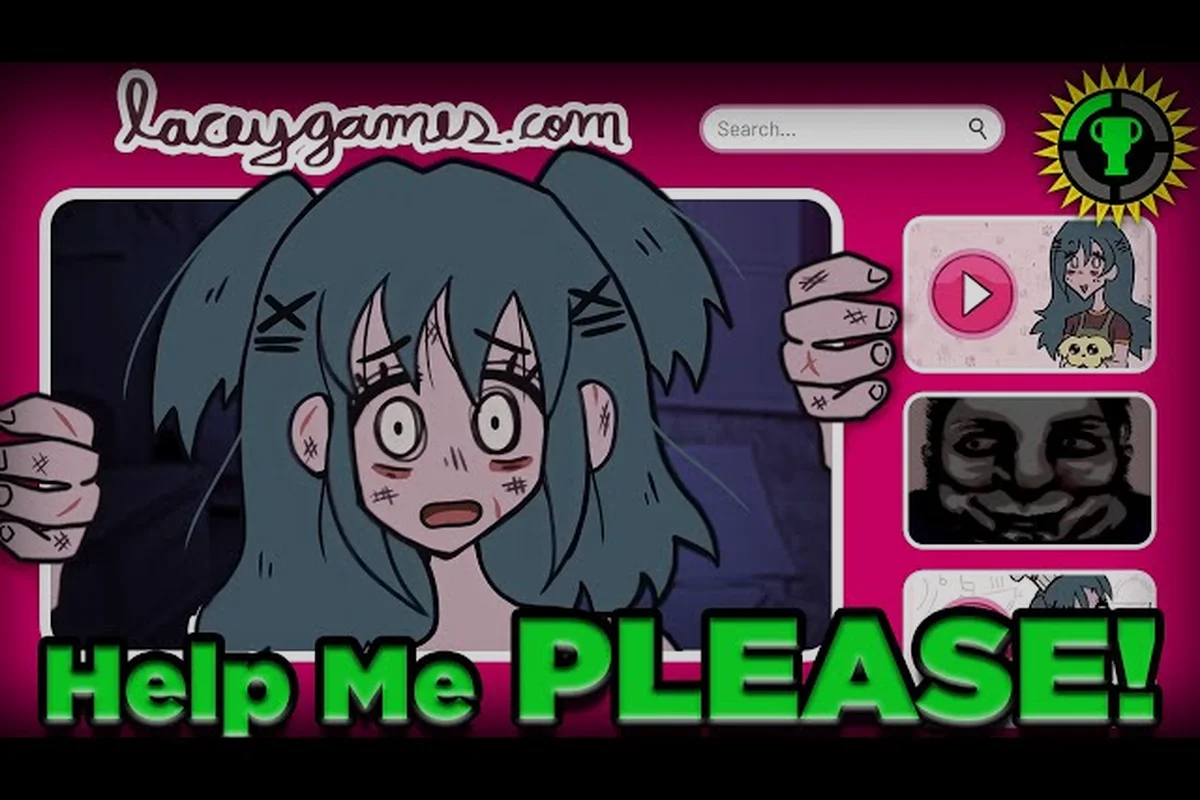
Lacey's Flash Games theories work best when you treat the whole collection as one fragmented story rather than a set of unrelated minigames. The site's cute pastel packaging hides a timeline that rewards careful reading, and this breakdown connects the clues so the ending actually means something.
Why Lacey's Flash Games Theories Keep Circulating
The reason people keep building Lacey's Flash Games theories is that the game never hands you a clean narrative. You get bright browser-game frames, cheerful prompts, and then small details that don't fit — a locked door, a name that changes, a reward that feels like a warning. Community reports consistently describe the same reaction: the more you replay, the more the innocent surface starts to feel deliberate.
That ambiguity is the point. A straightforward horror game tells you what to fear; this one makes you assemble the fear yourself, which is why a proper Lacey's Flash Games analysis has to look at structure, not just scares.
-
Framing device: the games are presented as a website collection, so the "site" itself becomes part of the story.
-
Escalating tone: early minigames feel harmless, later ones carry heavier visual and narrative weight.
-
Unreliable presentation: text and imagery sometimes contradict each other, which is the core engine of most fan theories.
-
Reward inversion: completing tasks often produces discomfort instead of satisfaction.
The most useful starting point is to separate what the game shows from what players infer. Shonyx's playthrough "LACEY'S GAMES IS SUPER WHOLESOME (im lying)" captures this split well — the commentary laughs at the wholesome framing while the footage quietly piles up unsettling details. Watching that contrast is often what tips a casual player into theory-crafting.
Keeping Evidence Tiers Honest
Before diving into any Lacey's Flash Games deep dive, be honest about evidence tiers. Canon is what appears on screen and can be re-verified by replaying. Inference is what the community reads into framing, color, and sequencing. Most arguments online happen because someone presents inference as canon. Keeping the two separate makes your own reading far more defensible and lets you spot which theories actually hold up under replay.
Mapping the Lacey's Flash Games Lore Timeline
Any credible Lacey's Flash Games lore timeline has to solve one problem: the games don't present events in strict chronological order. Instead, the collection layers present-day website framing on top of in-game events, and the two timelines bleed into each other. The table below lays out the most widely supported reading, drawn from community discussion rather than an official statement.
| Timeline Layer | What It Represents | Key Evidence | Theory Weight |
|---|---|---|---|
| Site framing | The "present" of the website | Menu text, site branding, navigation | Strong — visible every session |
| Early minigames | A calmer past or idealized memory | Bright colors, simple tasks, gentle prompts | Moderate — tone-based |
| Mid-collection shift | The turning point | Darker palettes, harsher failure states | Strong — consistent across playthroughs |
| Late-game content | Consequence or aftermath | Locked areas, altered text, heavy imagery | Strong — most analyzed segment |
| Endings | Interpretation layer | Choice framing, cover/avoid options | Contested — multiple readings |
The pattern most players agree on is a descent structure: the collection starts light and gets heavier, and that arc mirrors a story moving from normalcy to rupture. Whether that rupture is literal (something bad happened) or psychological (something was always wrong) is where the Lacey's Flash Games timeline debate splits.
Reading the Shift as a Turning Point
The mid-collection tonal shift is the single most important anchor for dating events. If you treat the early minigames as "before" and the late ones as "after," the timeline becomes legible: the site framing sits outside the story as a kind of archive, while the minigames narrate what the archive contains. That archive framing is also why the full story breakdown of the site's lore is worth reading alongside this timeline — the two readings reinforce each other.
Where the Timeline Gets Contested
Two camps dominate. The linear camp argues the minigames are sequential memories in order. The fragmented camp argues they're deliberately shuffled, and the "correct" order is thematic rather than chronological. The fragmented reading explains more of the inconsistencies, but it also makes any single timeline unprovable — which is exactly why the debate never dies. For a theory to survive, it should explain at least one detail the other camp can't.
Decoding the Lacey's Flash Games Ending Meaning
The Lacey's Flash Games ending meaning is the most argued-about piece of the whole collection, and for good reason: the ending is where the game stops being a set of minigames and becomes a statement. The choice framing matters more than any single image, because it forces the player to decide what kind of story they were in.
| Ending Reading | Core Claim | Supporting Clues | Main Weakness |
|---|---|---|---|
| Literal tragedy | Something bad genuinely happened to a character | Heavy late-game imagery, altered text | Doesn't explain the cheerful framing |
| Psychological reading | The "site" is a coping structure | Repetition, avoidance mechanics, cover options | Hard to pin to specific scenes |
| Meta-commentary | The game is about browser-game nostalgia and exploitation | Site branding, marketing parody, audience framing | Can feel detached from character stakes |
| Ambiguous by design | No single answer is intended | Contradictions left unresolved | Unsatisfying for lore hunters |
The strongest Lacey's Flash Games ending explained lore readings tend to combine the first two: a real event filtered through a protective, cheerful interface. That combination explains both the heavy content and the relentless cuteness without discarding either.
Why the Cover Choice Matters
The choice to cover or avoid is the clearest authorial signal in the game. Choosing to cover reads as protection — hiding something from view, whether to shield a character or to hide from the truth. Choosing to confront reads as exposure. Neither is framed as "correct," which is why the detailed breakdown of the cover-Lacey ending is useful: it isolates the single decision that reshapes how you read everything before it.
The Ending as a Thesis Statement
If you accept that the ending is deliberately unresolved, then the game's thesis is about the impossibility of a clean account of trauma or memory. The minigames are fragments; the site is the narrator trying to organize them; the ending is the narrator failing to fully succeed. That reading makes the ambiguity a feature, not a bug, and it holds up better than any theory requiring a hidden "true" ending.
Recurring Symbols Across the Minigames
Symbol hunting is where a Lacey's Flash Games analysis gets the most traction, because symbols repeat across otherwise unrelated minigames. Repetition is the closest thing this game has to authorial emphasis — if an image shows up three times, it's probably load-bearing.
| Symbol | Where It Appears | Common Interpretation | Confidence |
|---|---|---|---|
| Bright pastel framing | Menus, early games | Safety mask over darker content | High |
| Locked or blocked areas | Mid-to-late content | Repressed or inaccessible memory | High |
| Repetition of tasks | Multiple minigames | Compulsion, routine, avoidance | Moderate |
| Altered or inconsistent text | Late-game screens | Unreliable narration | Moderate |
| Cheerful mascot energy | Throughout | Satire of girls-game marketing | Moderate |
The pastel framing is the most reliable symbol because it's constant. It functions as a tone contract with the player: you're promised something harmless, and the game slowly breaks that promise. The mascot energy works the same way, and it's the thread that connects this collection to the broader dark humor and psychological horror reading that many players arrive at after their first unsettling playthrough.
Symbols That Probably Mean Less Than You Think
Not every repeated detail is a clue. Some repetition exists for pacing or because the collection reuses assets. A good filter: ask whether a symbol changes meaning depending on where it appears. If it doesn't, it's probably texture rather than signal. Applying that filter cuts most weak theories immediately and leaves a smaller, sturdier set of claims worth defending.
Cross-Referencing Symbols With the Timeline
Symbols gain power when mapped onto the timeline. A locked door in an early minigame reads as a minor obstacle; the same door late in the collection reads as a sealed memory. This is why the strongest theories don't just list symbols — they track when each symbol appears and how its meaning shifts as the collection darkens.
Building Your Own Theory Without Overreaching
The healthiest way to engage with Lacey's Flash Games theories is to build a reading that survives scrutiny. That means starting from verifiable details, then layering interpretation on top, and being explicit about which is which. The checklist below is a practical method any player can run after a fresh playthrough.
- Replay the collection and note every tonal shift with a timestamp or minigame name.
- List repeated images and mark whether their meaning changes by context.
- Separate on-screen facts from your interpretation in two columns.
- Test your theory against the ending — does it explain the choice framing?
- Check whether a simpler explanation covers the same evidence.
- Compare against community readings and note where yours diverges and why.
The final step matters most. A theory that only works if you ignore three inconvenient details isn't a theory; it's a preference. The readings that endure in this fandom are the ones that account for contradictions instead of deleting them.
Common Theory Pitfalls
Three traps catch most newcomers. First, treating the site framing as neutral when it's clearly part of the fiction. Second, assuming a hidden true ending exists — no verified evidence supports one, and community reports treat the ambiguity as intentional. Third, over-reading asset reuse as symbolism. Avoiding these three keeps a reading grounded and makes it far more persuasive when you present it.
Where the Community Consensus Actually Lands
Stripping away the extremes, most players converge on a middle position: the collection is a deliberately ambiguous work about memory, protection, and the gap between a cheerful surface and heavier content. Whether you call that trauma, satire, or pure atmosphere is a matter of emphasis. That consensus is loose but durable, and it's the safest foundation for any new theory you want to propose.
Frequently Asked Questions
What is the most popular Lacey's Flash Games theory?
The dominant reading is that the cheerful website framing masks a darker underlying story about memory and avoidance. Community discussion consistently favors this over purely literal or purely meta explanations because it accounts for both the heavy late-game imagery and the relentless cute presentation without discarding either side.
Is there a confirmed official timeline for the story?
No official chronological timeline has been published. The widely used Lacey's Flash Games lore timeline is a community reconstruction built from tonal shifts, repeated symbols, and the order in which content appears. Treat it as a strong interpretive framework rather than verified canon, and expect disagreement on the exact sequence of events.
Does the ending have one correct interpretation?
The ending is deliberately unresolved, and no verified source confirms a single true meaning. The cover-or-confront choice is the clearest authorial signal, but it's framed without a "correct" option. Most durable readings combine a literal event with a psychological layer, which explains both the heavy content and the protective framing.
Are the minigames in chronological order?
Probably not in a strict sense. The fragmented reading explains more inconsistencies than the linear one, suggesting the minigames are organized thematically rather than sequentially. That said, the early-to-late tonal descent is real and consistent, so the collection does have a directional arc even if individual events aren't neatly dated.
How do I tell a strong theory from a weak one?
A strong theory explains the ending, accounts for repeated symbols, and survives inconvenient details instead of ignoring them. A weak theory relies on a single clue, assumes a hidden true ending, or treats reused assets as deep symbolism. Test any reading against the full collection before treating it as settled.
The through-line across all of these Lacey's Flash Games theories is simple: the collection rewards players who read structure, not just scares. Track the tonal descent, separate canon from inference, and let the ending reframe what came before — that method produces readings that hold up long after the first unsettling playthrough.