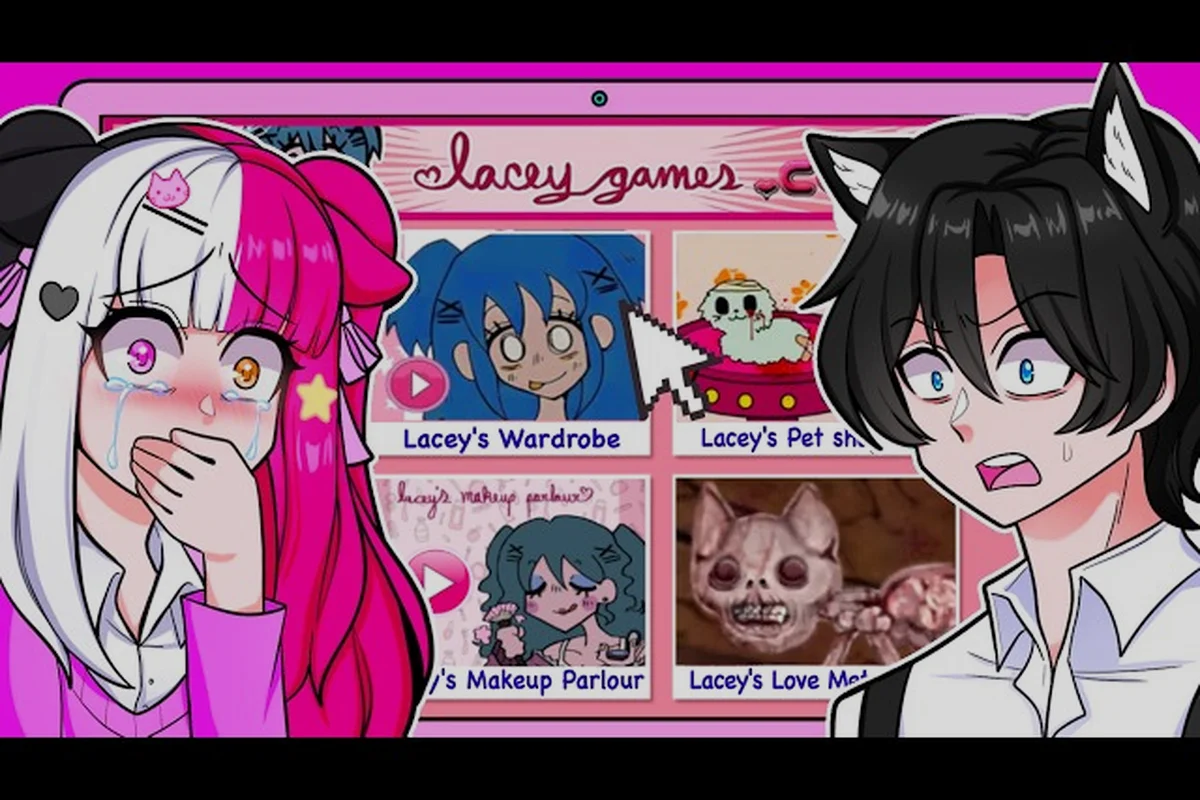
The dark humor in Lacey's Flash Games works because every joke hides a wound, and understanding that balance is the key to reading the whole story. This breakdown unpacks the dark humor meaning, the psychological horror story underneath, and how the flash game ties into the wider Lacey Games web series.
Why the Jokes Feel Wrong on Purpose
The comedy in Lacey's Flash Games is engineered to make you laugh and then feel bad about laughing. That discomfort is the point. The game presents itself as a cheerful girls' games portal, complete with pastel colors, smiling characters, and chirpy instructions — then quietly slides something disturbing into the frame. The dark humor meaning lives in that gap between the wholesome surface and the bleak reality underneath.
Community players often describe the experience as "wholesome until it isn't," and that phrasing captures the design philosophy precisely. The jokes are not random cruelty; they are deliberate tonal sabotage that trains you to distrust the cheerful narrator. Consider how the pastel girls-games framing sets your expectations for a gentle, low-stakes browser toy, so the first grim beat lands while your guard is still down — a bait-and-switch the Lacey's Flash Games horror backstory later recontextualizes as something closer to psychological horror story than shock humor. Each gag is calibrated so the laugh arrives a half-second before the dread, and that timing is what makes the dark humor meaning stick: the game is teaching you, joke by joke, that the friendly surface is the unreliable part.
-
The cheerful tutorial voice gives instructions that are subtly threatening.
-
Bright girls-games branding contrasts with grim outcomes for the characters.
-
Deadpan delivery of horrifying lines makes them land as comedy before the dread sets in.
-
Repeated cheerful catchphrases become unsettling once you know the backstory.
This is why the humor reads as dark rather than simply mean. The game never winks at you directly — there's no narrator nudging your ribs to confirm the joke is safe, no winking emoji to release the tension. Instead it lets the contrast do the work: a pastel girls-games portal voice cheerfully announcing a grim outcome, and your own brain supplies the uncomfortable laugh a beat too late. That absence of a comedic safety net is what separates the lacey's flash games dark humor meaning from shock-for-shock's-sake — the deadpan delivery trusts you to catch the mismatch yourself, so the guilt arrives before the punchline fully lands.
The Wholesome-to-Horror Pivot
The pivot usually happens in small increments. A character smiles a little too long, a background detail changes between screens, or a line of dialogue contradicts something said earlier. According to community reports, the most effective scares are the ones players only notice on a second playthrough, because the first run is spent trusting the presentation.
That structure is borrowed from analog horror, where the horror comes from corrupted media rather than monsters. The flash game format — cheap, nostalgic, slightly broken — is the perfect vehicle, since players already associate old browser games with a certain innocence.
The Psychological Horror Story Beneath the Jokes
Strip away the jokes and what remains is a psychological horror story about control, performance, and the cost of being watched. The narrative follows a protagonist whose cheerful exterior is maintained under pressure, and the humor functions as a coping mechanism for both the character and the player. The horror backstory is never dumped on you in one exposition scene; it accumulates through environmental details, contradictory dialogue, and the slow realization that the narrator is not reliable.
If you want the full sequence of events laid out, the Lacey's Flash Games lore breakdown walks through the plot beats in order. What matters here is how the story's structure produces the humor.
| Story Layer | Surface Presentation | What It Actually Means |
|---|---|---|
| The narrator's tone | Friendly, encouraging | Manipulative, controlling |
| The mini-games | Lighthearted challenges | Tests of compliance |
| The character's smile | Happiness | A performance under duress |
| The rewards | Praise and stars | Conditional approval |
| The "bad" endings | Failure states | Moments of honesty |
The table above shows the core trick: every element has a cheerful reading and a bleak reading, and the dark humor meaning emerges when you hold both at once. The game is funny because the cheerful reading is so obviously forced.
Why the Protagonist's Smile Is the Punchline
The recurring smile is the single most important visual gag in the game. On the surface it signals a happy character; in context it signals someone holding themselves together. Players who have finished the game report that the smile becomes genuinely disturbing on replay, because you now know what it is covering.
That is a sophisticated use of humor. The joke is not "look at this creepy face" — it is "look at how hard this person is pretending." The psychological horror story is about the effort of maintaining that performance, and the comedy is the sound of the mask slipping.
How the Flash Game Connects to the Lacey Games Series
The flash game is not a standalone curiosity; it is a piece of a larger puzzle. The connection to the Lacey Games series runs through shared characters, recurring visual motifs, and a consistent tone of cheerful menace. Players who only played the browser game often miss the references that tie it to the broader web series.
The web series connection works in both directions. The flash game plants details that pay off in later installments, while the series retroactively makes the game's jokes darker. Community analysts have mapped several of these links, and the pattern suggests deliberate long-form planning rather than coincidence.
| Element | In the Flash Game | In the Wider Series |
|---|---|---|
| The narrator | Cheerful tutorial voice | Recurring unseen presence |
| The smile motif | Character sprite | Reappears in later episodes |
| The girls-games branding | Portal aesthetic | Satirical commentary on the genre |
| The "failure" states | Game over screens | Echoed in series plot points |
| The hidden messages | Background text | Expanded lore threads |
The Lacey Games series lore treats the flash game as an origin point — the innocent-looking artifact that later turns out to be evidence. That retroactive framing is what gives the dark humor its staying power, because the jokes you laughed at early become clues you should have noticed.
For a deeper look at how the series' mysteries are debated, the Lacey's Flash Games theories collection gathers the most popular readings of the timeline and ending. The most-cited thread ties the "failure" game-over screens to the narrator's cheerful tutorial voice: each death message reframes a girls-games genre trope as a quiet threat, which is precisely the dark humor the series later weaponizes. Because the flash game hides its background-text messages behind the same pastel portal aesthetic, theorists argue the jokes only read as clues once the web series reveals the narrator as a recurring unseen presence. That retroactive reframing — punchline first, evidence later — is the mechanism the theories collection keeps returning to.
Shared Motifs Across Installments
The series reuses a small set of motifs with almost ritualistic consistency: the smile, the pastel palette, the cheerful voice, and the sudden intrusion of something wrong. Each reappearance adds weight, so a gag that was mildly funny in the flash game becomes genuinely unsettling by the time it resurfaces later.
That is how the humor evolves across the series: the first installment's punchline is simply that a fake girls' games portal exists at all, but each later entry shifts the target of the joke, so by the final installment the laughter lands on the player who kept clicking through warning signs, broken links, and the recurring smile motif. What begins as a parody of the pastel portal's cheerful framing becomes a self-aware commentary on the audience's complicity — the dark humor meaning depends on recognizing that the series is laughing at you, not with you, and that recognition is what turns the smile from a gag into a psychological horror device.
Reading the Bleak Jokes as Commentary
Once you accept that the humor is intentional, a second layer appears: the jokes are commentary on the genre the game is imitating. The girls-games marketing of the 2000s promised empowerment and fun while often delivering shallow, repetitive content, and the game exaggerates that promise until it curdles. The satire is affectionate but pointed.
The laceygames.com website lore extends this further, treating the fictional portal as a character in its own right. According to community discussion, the site's cheerful branding is part of the joke — a storefront that sells happiness while something darker operates behind the counter.
-
The pastel aesthetic parodies real girls-games portals.
-
The endless mini-games mock repetitive browser content.
-
The praise mechanics satirize reward loops designed to keep players clicking.
-
The hidden horror critiques the gap between marketing and reality.
This is why the dark humor meaning is not just "creepy things happen." The game is making a specific argument about the media it grew out of, and the jokes are the delivery system for that argument. The praise mechanics are the clearest example: each compliment the player earns follows the same escalating loop as a real girls-games reward system, but the game withholds the payoff the genre once promised, so the joke lands as a diagnosis rather than a scare. The hidden horror then functions as the punchline to that setup — the darker content is what the cheerful storefront was always concealing, which is why the humor reads as targeted critique of 2000s browser portals rather than random shock value.
The Narrator as the Real Villain
The narrator deserves special attention because the humor depends on them. They are relentlessly upbeat, endlessly patient, and completely unwilling to acknowledge anything is wrong. That combination is funny at first and terrifying later, which is exactly the arc the game wants.
The Lacey's Flash Games Grace narrator analysis digs into who is actually speaking and why their cheerfulness reads as a threat. Understanding the narrator reframes every joke in the game, because you realize the humor is being told to you by someone with an agenda.
Why the Dark Humor Meaning Still Resonates
The reason this game's humor lingers is that it targets something real: the pressure to perform happiness. The psychological horror story is not about monsters or ghosts — it is about the exhausting work of maintaining a cheerful front while something is deeply wrong. That is a fear most players recognize immediately.
Community reports consistently highlight the same moments as the most affecting: the forced smile, the cheerful instructions that contradict reality, and the rewards that feel like bribes rather than praise. These are not random scares; they are the vocabulary of the game's central theme.
| Humor Technique | Example in Game | Emotional Effect |
|---|---|---|
| Tonal whiplash | Cheerful voice, grim content | Uneasy laughter |
| Deadpan horror | Flat delivery of awful lines | Delayed dread |
| Dramatic irony | Player knows what character doesn't | Helpless tension |
| Absurd escalation | Small wrongness grows | Mounting anxiety |
| Callback jokes | Early gags return darker | Retroactive unease |
The dark humor meaning, then, is a form of honest comedy — it uses jokes to talk about something painful without ever naming it directly. That indirectness is what makes it work, and it is why the game stays with players long after the browser tab closes.
The Difference Between Creepy and Cruel
It is worth noting that the game never punches down. The jokes target the situation, the narrator, and the media genre — not vulnerable people. That distinction is why the humor reads as dark rather than mean-spirited, and it is a big part of why the community embraces it rather than rejecting it.
Games that mistake cruelty for comedy lose their audience quickly, because a joke with no recognizable pain behind it reads as mere provocation. This one earns its darkness by making the target something the player also feels — the dread of a corrupted Flash file, the uncanny gap between a cheerful mascot and a glitched sprite, the slow erosion of trust in the narrator — so the punchline lands on the player's own nerves rather than on a victim. That structural choice turns the joke into a shared recognition instead of an attack, and it is precisely why the dark humor in Lacey's Flash Games reads as unsettling insight rather than shock for its own sake.
How to Spot the Hidden Jokes on a Replay
The game rewards a second playthrough more than most horror titles, because the jokes are layered. On the first run you laugh at the absurdity; on the second you notice the foreshadowing. Here is a practical approach to catching what you missed.
-
Watch the background details during cheerful scenes — they change more than you think.
-
Compare narrator lines across scenes for contradictions.
-
Note every time the smile sprite appears and what precedes it.
-
Track the reward language for signs of manipulation.
-
Read the hidden text in menus and loading screens carefully.
Players who have done full replays report that the second run feels like a different game, because the humor shifts from surprise to dread. The jokes are the same, but your understanding of them has changed. The reason is structural: the game front-loads absurdity in early scenes, so a first-time player reads the narrator's cheerful lines as comic relief, while a returning player already knows the horror backstory those lines are quietly setting up. That gap is where the dark humor meaning lives — a punchline like the smile sprite appearing after a reward prompt lands as a gag on run one and as a threat on run two, since you now recognize the reward language as manipulation rather than generosity.
Documenting the Details
Many community members keep notes on repeated motifs, and that practice pays off. The game's design assumes attentive players, so the more carefully you watch, the more the dark humor meaning reveals itself. Small consistencies — a color that recurs, a phrase that echoes — are usually intentional.
If you suspect there is more going on than a straightforward horror story, the debate over whether the game is an ARG covers the hidden-meaning theories in detail. Whether or not you buy the ARG reading, the exercise sharpens your eye for the details that make the jokes land.
Frequently Asked Questions
What does the dark humor in Lacey's Flash Games actually mean?
The dark humor meaning is the contrast between the game's cheerful presentation and its bleak underlying story. The jokes work by making you laugh at something disturbing before you fully understand it, so the comedy and the horror reinforce each other rather than canceling out.
Is Lacey's Flash Games part of a larger series?
Yes. The flash game connects to the wider Lacey Games web series through shared characters, recurring motifs like the smile, and consistent tonal choices. Details planted in the game pay off in later installments, which is why community analysts treat it as an origin point for the series lore.
Why is the narrator so unsettling?
The narrator stays relentlessly cheerful no matter how grim the situation becomes, and that refusal to acknowledge reality reads as manipulative. The humor depends on this disconnect, because the narrator's upbeat tone is what makes the disturbing content land as both comedy and threat.
Do I need to replay the game to understand the jokes?
A replay helps considerably. Many of the jokes are foreshadowing that only becomes visible once you know the ending, so a second playthrough shifts the humor from surprise to dread. Community players frequently report that the game feels different the second time through.
Is the horror backstory confirmed or just fan theory?
The core backstory is supported by in-game details and consistent across the series, while specific interpretations remain debated among fans. Community analysis has mapped the major beats, but some questions about the timeline and ending are still open to interpretation.